Arab Blocs Hold Key in Stalemate
Record turnout gives 19 seats to parties that can block or enable a government in Israel's hung parliament.
By Lucas Navarro ·
Arab-led parties won 19 of the 120 seats in the Israeli Knesset after last month's election, leaving neither Prime Minister Benjamin Netanyahu nor his rival Gadi Eisenkot with the 61 seats needed to form a government.
The result grants the bloc a decisive role in coalition talks. The Central Elections Committee reported a 64% increase in votes for these parties compared to the previous cycle. This surge followed record voter turnout among Palestinian citizens of Israel.
Jamal Zahalka, chairman of the High Follow-Up Committee, told reporters the community had found its strength. He stated that the vote blocked the continuation of Netanyahu's government, which he called a historical achievement.
Netanyahu and his allies framed the high Arab turnout as an emergency. On election day, the prime minister posted a video describing the situation in those terms. Itamar Ben Gvir, the national security minister, filmed an appeal at the entrance to Kufr Qasim urging voters to keep the country Jewish and Zionist.
The Likud party later alleged that Arab parties had stolen the election through bribery, threats, and forgery. They warned of a foreign takeover and the Islamization of Israel. The party has not made evidence public for these claims. Police found no basis for the allegations, and election officials reported no widespread fraud.
The head of the elections committee asked the Shin Bet security service to investigate suspected foreign funding of efforts to boost turnout. The attorney general and the elections committee head both said the vote was conducted properly and the results were not compromised.
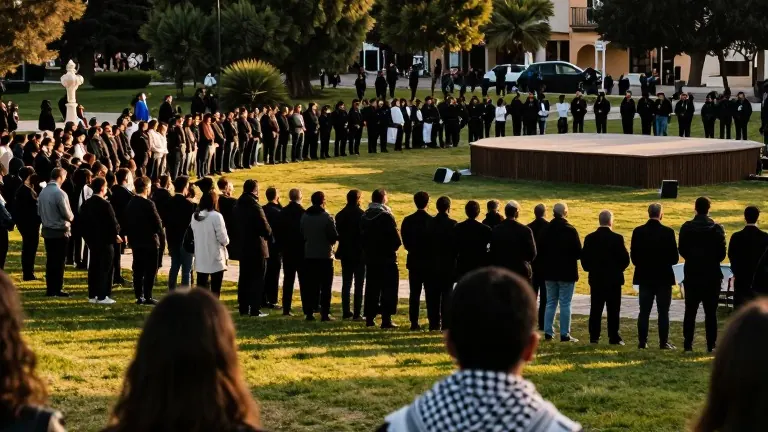
In Kufr Qasim, residents gathered in a park to commemorate 70 years since the 1956 killings by border police. The event served as a memorial for those lost in the Suez Crisis era and a protest against current conditions. Intisar Sarsur, 65, said her family participated because they were seeking basic human rights. She noted that no one in her circle stayed home.
Sarsur said the olive harvest, usually a joyous time, felt bittersweet this year due to attacks by settlers in the West Bank. She described the atmosphere as one where there is no freedom anymore. Her family shared mutabbaq, a sweet layered pastry, and fresh olive oil from the current crop.
Eisenkot, a former military chief of staff, faces a difficult path to partnership. His son was killed fighting in Gaza, and he served in Netanyahu's war cabinet early in the conflict. He is known for the Dahiyeh doctrine, a 2008 strategy involving disproportionate force against villages firing militants. This history makes an alliance with Arab parties politically risky for his center-right bloc.
Arab parties are divided on their strategy. Ra'am, a socially conservative Islamist party, campaigned on joining a governing coalition and placed a Jewish former police official second on its list. The Joint List alliance, which won 11 of the 19 seats, said it would not formally partner with Eisenkot. It cited the ongoing war in Gaza and the occupation of the West Bank as reasons to back him from the outside instead.
President Isaac Herzog is consulting with parties to determine who will receive a mandate to form a government. He is expected to announce his choice next week. The chosen candidate has 28 days to form a coalition, with a possible two-week extension. If that fails, a second candidate gets 28 days without an extension. A failure by both would trigger repeat elections next year.
Mansour Shaaban, 33, said he would vote again immediately. It was his first time voting. He said the extreme right made co-existence impossible. He noted that even if change is not created this time, right-wing politicians now know Palestinian citizens have found their voice.